
Pluralsight: Turning a Fragmented Design Function Into a Real Operation
Building the operational backbone, tooling and team practices that kept a design organization running through years of upheaval without losing continuity.
When I joined Pluralsight as Director of Product Design, the design function had no real structure, no shared standards and no governance. The company had also grown by acquiring nine companies in six years and none had been reconciled into one coherent product experience. The company was under private equity ownership with priorities shifting constantly. A startup-era “autonomy above all” mindset had also outlived the stage the company was actually in.
$926k
Saved consolidating 28 tools to 7
40%
Reduction in time-to-design
31%
Lift in team peer connection
92%
Wanted team off-sites to occur yearly
Problem
I ran a 30-day listening tour across product, engineering, brand and design to find where the friction actually lived. Then I mapped what I heard against the Nielsen Norman Group’s DesignOps Menu. Fourteen of the framework’s 27 categories came back as real gaps:
- No organizational structure or defined team composition
- No communities of practice connecting people across teams
- Hiring and onboarding handled ad hoc, with no career development practice
- No guiding principles, design process or consistent toolset
- 28 different tools running in parallel, many of them ungoverned trials at real risk of losing work
- A design system, PSDS, that had become a liability: 60+ packages, nested dependencies and frequent breaking changes
- No shared research hub
- No consistent process for allocating work
- No agreed design standards
- No clear definition of the value the function delivered
- No skills training
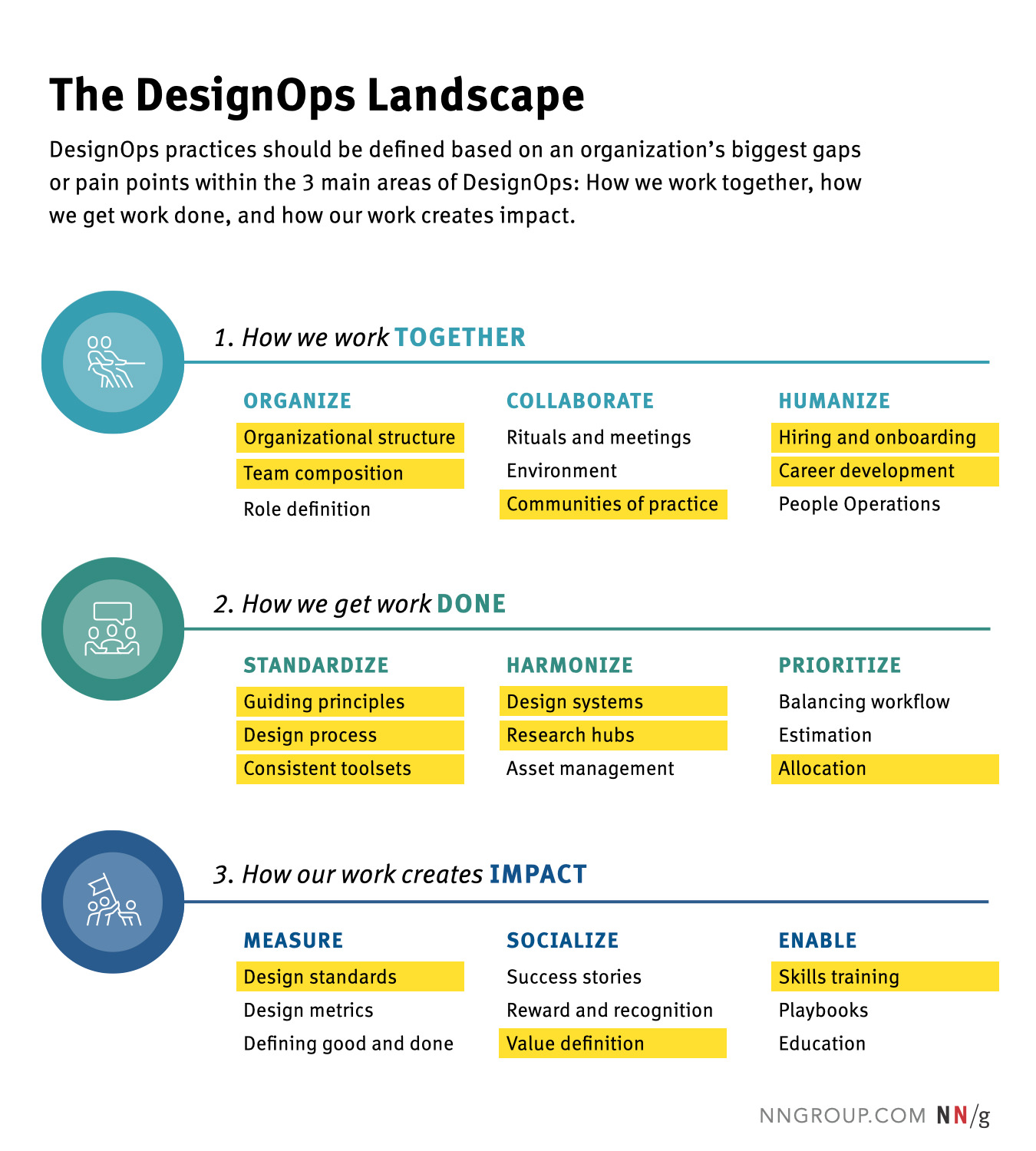
The DesignOps Menu I used to assess Pluralsight, highlighted with the gaps my listening tour found.
Approach
Centralizing the Function
I advocated for a centralized design organization to senior leadership, including the case for creating the company’s first Head of Design role. I wrote the job description, built the interview process and took part in interviews for the hire.
UX Strategy & Architecture
About two years in, once the org had enough shared structure to support it, I launched a UX Strategy & Architecture function to bring consistency to how the product family fit together. A Cloud Guru, the largest of the nine acquisitions, was the biggest source of friction. I introduced service blueprinting to the team. They combined it with process flow maps to run an experience audit across the product line and see exactly how the pieces connected.
The senior designer on that team was already deep in Object-Oriented UX. I advocated for moving her onto the Strategy & Architecture team from elsewhere in the org so that skill set could actually be put to use. From there, she ran ORCA workshops, object mapping, relationship mapping, calls-to-action and attributes, to define a shared structure the whole product family, A Cloud Guru included, could build from.
Career Development
Career development had no real structure before this. I built a lattice. Every designer shares the same ten required core competencies, things like systems thinking, product thinking and data-informed decision-making. On top of that, each person has a specialization track, design, content or research, with its own skill set. Once a year, every designer builds a personal focus plan: two of their track’s core skills, plus four growth areas of their own choosing. People used it to deepen their craft, move into leadership or shift tracks entirely.
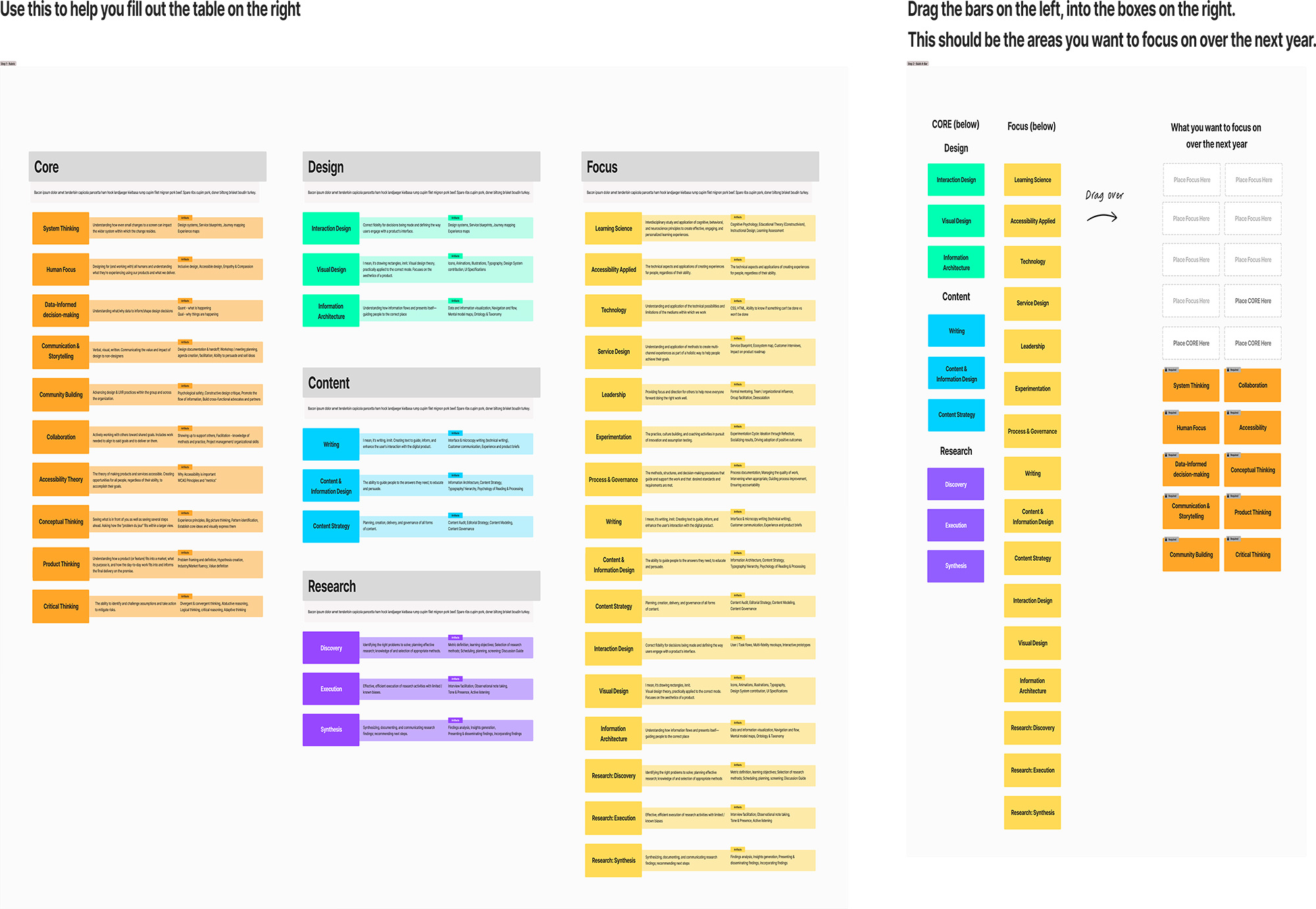
The career lattice I built: ten required core competencies, three specialization tracks, and a focus plan each designer sets for themselves every year.
Tooling & Governance
On tooling, I consolidated the stack from 28 tools down to 7 (Figma, FigJam, Pendo, FullStory, Maze, Jira and Confluence), each with a named owner, a defined purpose and an actual procurement process. Documented savings from the tools eliminated totaled $926,000, with a further dozen tools cut where the historical cost data no longer existed to total up.
Pando, the design system covered in its own case study, grew out of this same work and became the default frontend infrastructure for new product work across the company.
Leadership & Obstacles
Building this infrastructure during a stable period is one thing. Keeping it running through several years of significant organizational change is another. Headcount fluctuated while the scope of what the team owned kept growing. Junior designers needed more mentorship and more of my direct time, not less. The intake process, tool governance, cross-functional rhythms, design system delivery and research operations all had to survive that and they did.
The intake process alone shows how. Every request, bug or feature, started in Slack and got logged in Zendesk. Feature requests split two ways. General feedback routed straight to the product roadmap as insights. Escalations went to a biweekly cross-functional review with Product, Revenue and Engineering. If a request needed real discovery, that review assigned it out before anything got built. Approved work moved to Engineering with a clear owner and a paper trail back to the person who asked for it.
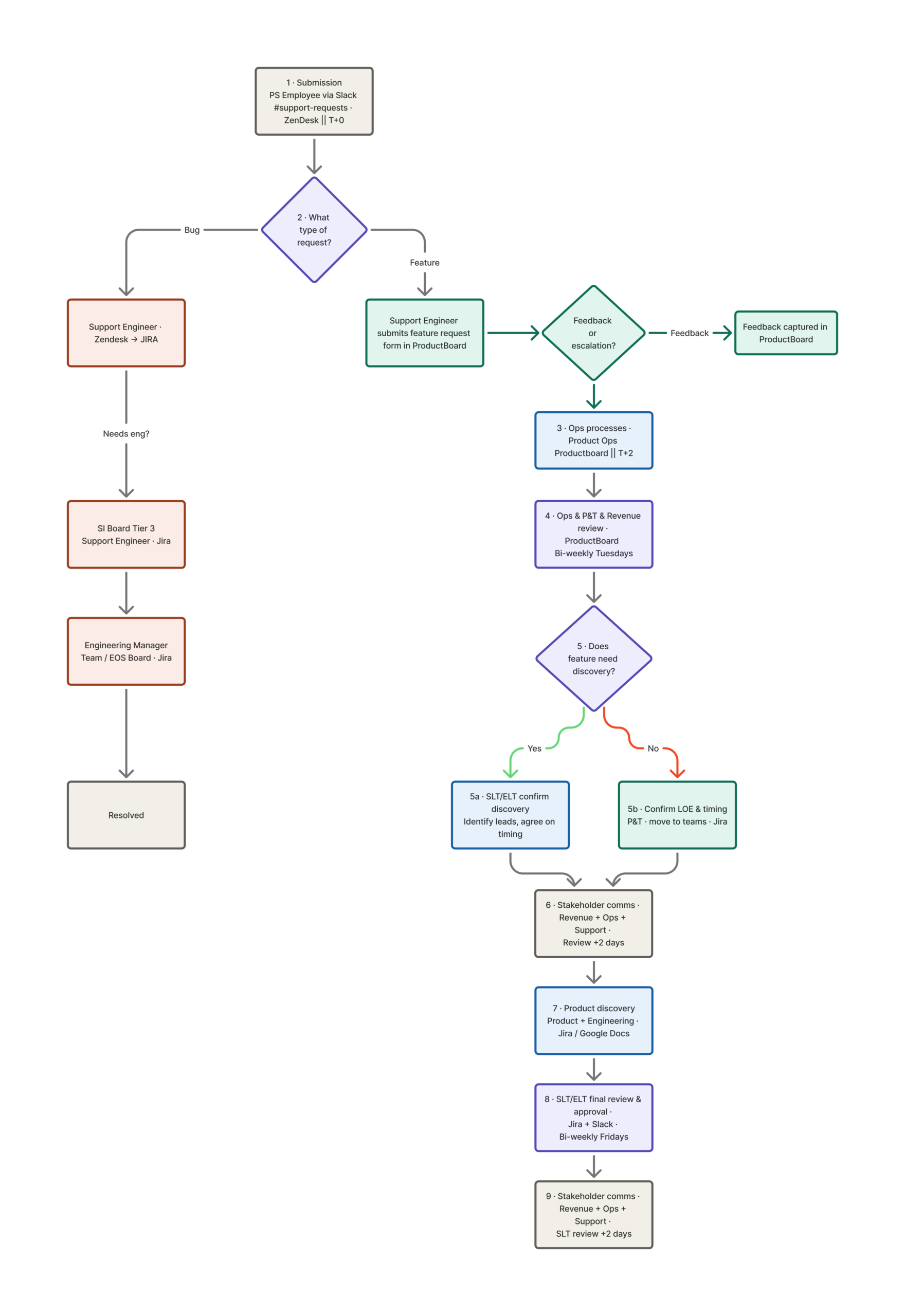
The intake and escalation workflow my Ops team built, routing every request from first submission to final approval with a clear owner at each step.
My own manager’s review put it plainly:
“Your steady leadership and ability to create clarity and ground your team during this time has been extremely valuable.”
Pluralsight had gone fully remote during the pandemic and never went back to an office. I had already co-planned and executed a similar onsite for the design team in Draper, Utah in December 2024. A few people missed it and design and product were still separate orgs at the time.
Once the two combined in 2025, most of that larger group had never been in a room together. In November 2025, I co-planned and executed a three-day Product & Experience Design onsite in Dallas for more than 20 people, on a compressed timeline, mixing structured workshops with unstructured time.
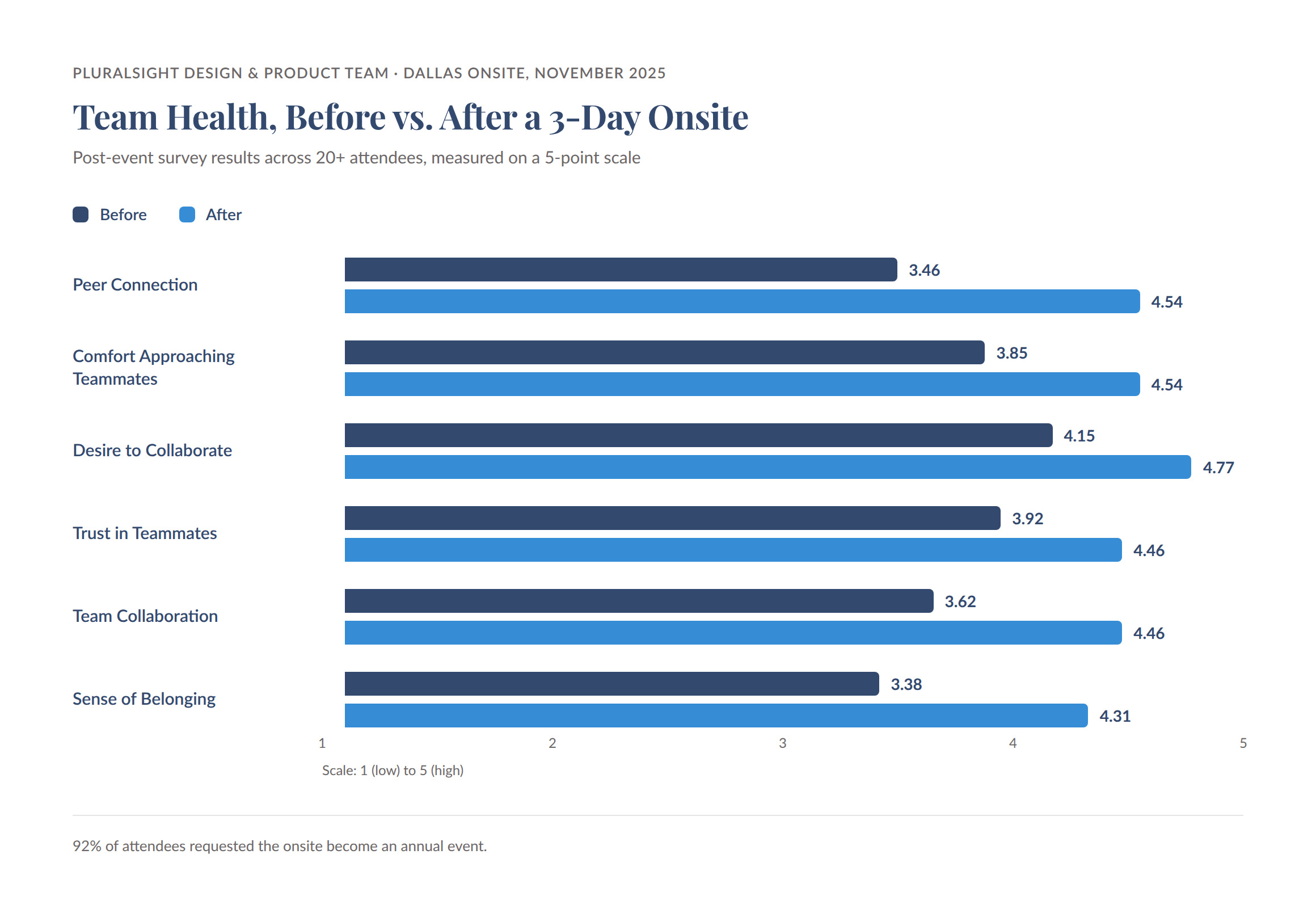
Pluralsight Design & Product Team – Dallas on-site survey results – November 2025
Why It Mattered
Under my leadership, Design and Product Operations at Pluralsight kept running through years of reorgs, tool consolidation and shifting headcount. New hires could find what they needed. Partner teams trusted the intake process. A team that had never met in-person still worked well together.